
What to Look For—and How to Compare
Choosing a hospital isn't as simple as finding the one with the highest rating.
Hospitals are measured in different ways, and a hospital that performs well in one area may not perform as well in another.
The most useful approach is to compare the measures that matter for the care you need.
Whether you're choosing a hospital for surgery, cancer treatment, a heart condition, childbirth, an emergency, or another type of care, the information below can help you make sense of hospital quality data.
Start With the Care You Need
Before comparing hospitals, identify what you are comparing them for.
Are you looking for a hospital for:
- A particular surgery or procedure?
Treatment for a specific condition?
Cancer care?
Heart care?
Childbirth?
Emergency care?
A complicated or high-risk condition?
This matters because hospital quality isn't one-size-fits-all.
A hospital may have excellent results for one type of care and average results for another.
Whenever possible, look for information about the specific procedure, condition, or type of care you need.
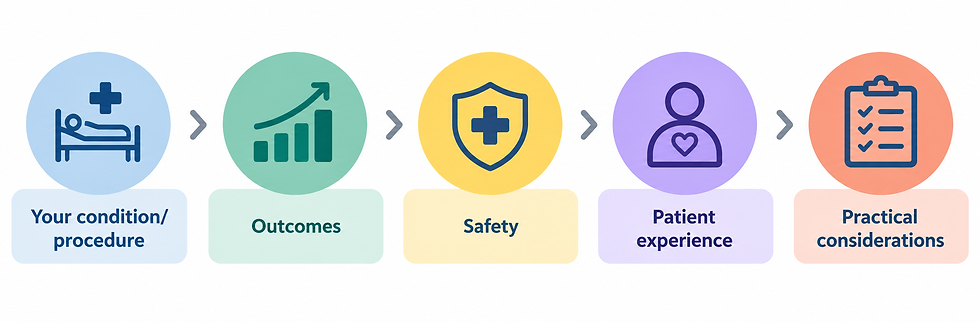
1. Outcomes
Outcomes tell you what happened to patients.
Depending on the type of care, you may find information about:
Mortality (deaths)
Complications
Readmissions
Infections
Problems following surgery or treatment
In plain language:
“What happened to patients who received care here?”
Outcomes can be some of the most useful information when you're comparing hospitals for a particular procedure or condition.
But remember that numbers can be affected by the types of patients a hospital treats. A hospital caring for many very sick or complicated patients may have different outcomes than a hospital treating healthier patients.
2. Patient Safety
Hospital safety measures look at things such as:
Hospital-acquired infections
Certain complications
Falls and other patient-safety events
Problems that may be preventable
Other measures of potential harm to patients
In plain language:
“How well does this hospital prevent things from going wrong?”
Safety is important for every patient—but especially when you're comparing hospitals for a planned procedure or hospitalization.
3. Patient Experience
Patients can tell you things that clinical data can't.
Hospital surveys may ask patients about:
Communication with doctors
Communication with nurses
Responsiveness of hospital staff
Communication about medications
Cleanliness
Quietness
Understanding what to do after leaving the hospital
Whether they would recommend the hospital
In plain language:
“How did patients say the hospital treated and communicated with them?”
Patient experience isn't the same thing as medical quality. A hospital can have excellent patient-experience scores without having the best clinical outcomes—and vice versa.
It's another piece of the picture.
4. Experience With Your Procedure or Condition
This is particularly important.
If you're having surgery or receiving specialized treatment, look for information about how much experience the hospital has with that specific type of care.
One measure you may encounter is procedure volume—how many times a hospital performs a particular procedure.
Higher volume can be useful information, but:
More procedures does not automatically mean better care.
Use volume alongside outcomes, safety and other information.
You can also ask your doctor how often they perform the procedure and how often it is performed at the hospital.
5. Compare Hospitals Side by Side
Once you've identified what matters for your care, compare two or more hospitals rather than looking at one hospital in isolation.
You don't need one hospital to be the winner in every category.
Instead, ask:
Which differences matter most for me?
For a major surgery, outcomes and experience with the procedure may be especially important.
For a routine hospitalization, safety and patient experience may carry more weight.
For a complicated condition, specialized expertise and experience treating similar patients may matter greatly.
Don't Rely on the Overall Rating
Many hospital comparison websites provide an overall rating, star rating or letter grade.
These can be useful for getting a quick sense of how a hospital compares with others.
But don't let one number make the decision for you.
An overall rating combines multiple measures. It may not tell you how a hospital performs in the particular area that matters most to you.
Instead, ask:
“What is behind the rating?”
Look at the individual measures whenever they're available.
A Good Place to Start: Medicare Care Compare
- Mortality
- Readmissions
- Patient safety
- Patient experience
- Timely and effective care
- Emergency department care
- Other hospital quality measures
How to use it
- Find the hospitals you're considering.
Search by location or hospital name. - Select the hospitals you want to compare.
If you have a choice, start with two or three. - Look beyond the overall rating.
Review the individual measures. - Focus on measures related to your care.
If you're having a particular procedure, look for procedure-specific information when available. - Look for meaningful differences.
Don't worry about small differences that probably aren't meaningful. Focus on measures where hospitals show a noticeable difference in performance.
Other Trusted Sources
Medicare Care Compare is an excellent starting point, but it isn't the only source worth checking.
Agency for Healthcare Research and Quality (AHRQ)
The Leapfrog Group
State Hospital Quality Resources
Your state may have its own hospital quality reporting program.
State programs can sometimes provide information about:
- Hospital quality
- Patient safety
- Infection rates
- Surgical outcomes
- Hospital charges or costs
- Other state-specific measures
U.S. News Best Hospitals
What About Hospital Reviews?
Online reviews can tell you about people's individual experiences, but they shouldn't be treated like clinical quality data.
A review might tell you:
“The nurses were wonderful.”
That's useful.
But it doesn't tell you whether the hospital has better surgical outcomes.
Likewise, a negative review doesn't necessarily mean the hospital provides poor medical care.
Use reviews for context.
Use standardized quality data for comparing quality and safety.
Don't Forget the Practical Questions
Quality data is important, but it isn't the only factor in choosing a hospital.
Consider:
Insurance
Is the hospital in your insurance network?
And just as importantly, are the doctors involved in your care in-network?
Location
How far will you need to travel?
How easy will it be for family or caregivers to visit?
Specialists
Does the hospital have the specialists you need?
Services
Does it have the emergency, intensive-care or other specialized services that might be important for your situation?
Your Doctor
Does your doctor practice at the hospital?
Can they explain why they recommend one hospital over another?
The Bottom Line
Don't ask:
“Which hospital has the highest rating?”
Ask:
“Which hospital performs well on the measures that matter for my care?”
Hospital quality data can be complicated. Ratings and rankings can be helpful, but they are only part of the story.
Use trusted sources. Look behind the ratings. Compare hospitals on the care you actually need. And talk with your healthcare team about what the numbers mean for you.